
An eSIM is also useful for IoT devices and smart systems, where physical SIM replacement is difficult. It helps maintain reliable connectivity for devices like smart meters, vehicles, and trackers.
Market Overview
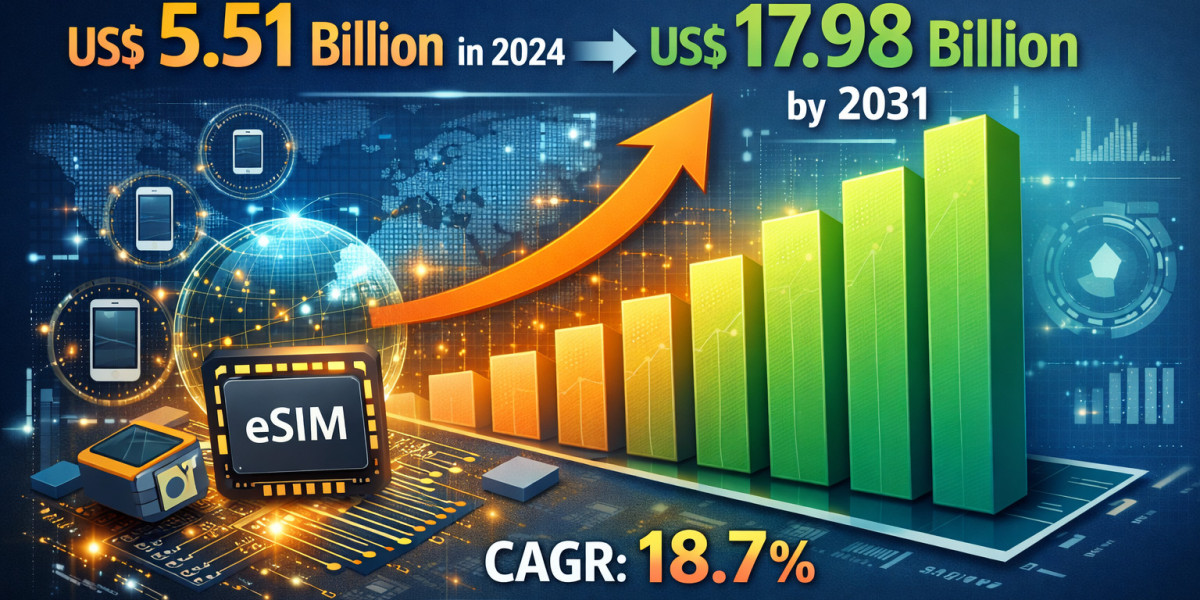
The global eSIM market is witnessing strong growth as digital connectivity becomes central to consumer and enterprise ecosystems. Valued at US$ 5.51 billion in 2024, the market is projected to reach US$ 17.98 billion by 2031, expanding at a CAGR of 18.7% during 2025 to 2031. An embedded SIM, or eSIM, is a digital SIM integrated directly into a device, allowing users to remotely download network profiles without inserting a physical card. This technology enables seamless activation, easy carrier switching, and support for multiple profiles on a single device.
The shift toward eSIM reflects a broader transformation in telecommunications, where convenience, flexibility, and digital-first experiences are becoming standard expectations. For consumers, eSIM eliminates the need to handle physical SIM cards and simplifies onboarding. For service providers and enterprises, it reduces logistics costs, improves operational efficiency, and supports large-scale device management across smartphones, tablets, wearables, and IoT deployments.
Market Drivers and Adoption Trends
One of the primary growth drivers is the increasing integration of eSIM technology in smartphones. Major manufacturers such as Apple, Samsung, and Google are embedding eSIM functionality across flagship and mid-range models. This has significantly increased consumer awareness and accelerated adoption. The transition from removable SIMs to embedded connectivity is expected to reshape mobile service delivery, with industry estimates suggesting that 98 percent of smartphone connections in North America could rely on eSIM technology by 2030.
The automotive sector is emerging as another major growth engine. eSIM enables continuous vehicle connectivity through remote provisioning and centralized network management. Connected vehicles can access real-time navigation, traffic information, remote diagnostics, emergency services, and over-the-air software updates. For automotive manufacturers, standardized embedded connectivity simplifies production and eliminates region-specific SIM variants, reducing supply chain complexity. Additionally, eSIM acts as a secure digital identity within the vehicle, ensuring encrypted communication and supporting the growing shift toward software-defined mobility.
Download Sample PDF:https://www.theinsightpartners.com/sample/TIPTE00002282
Opportunities in Travel and Digital Services
The travel industry is creating significant opportunities for eSIM adoption. International travelers increasingly prefer instant, affordable data connectivity without changing physical SIM cards or paying high roaming charges. Digital travel eSIM platforms allow users to purchase and install data plans before departure while retaining their existing phone number.
The importance of uninterrupted connectivity is reflected in consumer behavior, with a large majority of travelers considering internet access a critical factor when choosing destinations. For airlines and travel operators, integrating eSIM services into booking platforms has also opened new ancillary revenue streams. The ability to bundle connectivity services with travel experiences is expected to further accelerate adoption in this segment.
Segmentation Insights
Based on components, the market is divided into hardware and software and services. The hardware segment accounted for the largest share in 2024 due to the growing integration of embedded chips in consumer devices and connected infrastructure.
By type, the market is segmented into consumer eSIMs, IoT eSIMs, and travel eSIMs. Consumer eSIMs dominated the market, driven primarily by smartphone adoption. Within this segment, applications include smartphones, laptops, tablets, wearables, and connected vehicles. Meanwhile, IoT eSIMs are gaining traction in industries such as logistics, utilities, agriculture, and smart cities, where remote device management and scalability are essential.
Regional Analysis
North America led the global eSIM market in 2024, supported by high smartphone penetration, strong telecom digitalization, and growing demand for flexible connectivity solutions. The region also benefits from widespread availability of digital activation services and strong adoption among business users and frequent travelers.
Europe represents the second-largest market, driven by regulatory support for digital services and growing deployment in automotive and industrial applications. Asia Pacific is expected to witness rapid growth over the forecast period due to expanding smartphone markets in countries such as China and India, increasing IoT adoption, and ongoing investments in digital infrastructure.
Key Players
Giesecke Devrient GmbH
Telefonica SA
Deutsche Telekom AG
IDEMIA France SAS
Infineon Technologies AG
Vodafone Group Plc
NXP Semiconductors NV
KORE Wireless
STMicroelectronics NV
Thales SA
These companies are focusing on partnerships, GSMA-compliant platforms, and advanced connectivity management solutions to strengthen their global presence.
Future Outlook
The future of the eSIM market will be shaped by deeper integration with artificial intelligence and advanced connectivity management platforms. AI-driven analytics will enable dynamic network selection, predictive performance optimization, and personalized connectivity plans. The market is also moving toward an eSIM-only device ecosystem, particularly in smartphones, wearables, and connected vehicles. As 5G expansion, IoT deployments, and cross-border mobility continue to grow, eSIM will become a foundational technology for secure, scalable, and fully digital connectivity. The convergence of telecom, automotive, travel, and enterprise applications is expected to sustain strong growth and create new service innovation opportunities through 2031.
Related Reports: